The client is a real estate developer focused on residential property sales. Their primary objective was to generate qualified leads for their project and increase site visits and bookings.
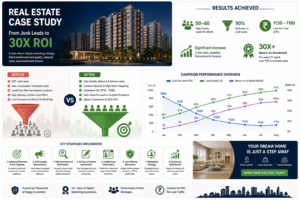
Initial Challenges
Before I took over, the campaign faced several critical issues:
- Poor Lead Quality
- Around 90% of leads were junk
- Fake numbers, incomplete data, or irrelevant inquiries
- Budget Mismatch
- Only 10% of leads were somewhat relevant, but many lacked purchasing power
- Location Targeting Issues
- Leads were coming from non-serviceable or irrelevant geographic locations
- High Wastage of Sales Team Effort
- Sales team spent most of their time filtering out bad leads instead of closing deals
- Low Conversion Rate
- Minimal site visits and almost negligible bookings
Objective
The primary goals were:
- Improve lead quality significantly
- Reduce junk and irrelevant inquiries
- Optimize cost per lead (CPL)
- Generate location-specific, high-intent leads
- Increase conversions and ROI
Strategy & Execution
After a complete audit of existing campaigns, I implemented a multi-layered strategy focused on targeting, messaging, and funnel optimization.
1. Audience Refinement & Geo Targeting
One of the biggest problems was irrelevant traffic. I redefined the audience strategy:
- Focused on high-intent geographic locations
- Excluded low-performing regions
- Layered targeting with:
- Income-based assumptions
- Property interest behaviors
- In-market real estate audiences
Result: Leads became more relevant and aligned with the project’s pricing.
2. Ad Campaign Restructuring
The previous campaigns lacked structure and clarity. I rebuilt them:
- Created separate campaigns for different audience segments
- Designed intent-based ad groups
- Used platform-specific strategies:
- Search campaigns for high intent
- Social campaigns for discovery and retargeting
Key Improvement:
- Shift from volume-based to quality-based lead generation
3. High-Intent Keyword Optimization
For search campaigns:
- Removed broad and irrelevant keywords
- Focused on:
- “Buy apartment in [location]”
- “Luxury flats near [area]”
- “Ready to move property”
- Added negative keywords to filter out:
- Low-budget searches
- Rental queries
- Job-related searches
Result: Higher intent traffic with better conversion probability
4. Ad Copy & Creative Optimization
Earlier messaging was too generic. I improved it by:
- Highlighting:
- Price range (to filter budget mismatch)
- Key amenities
- Location advantages
- Adding strong CTAs like:
- “Book Site Visit”
- “Limited Units Available”
For social media:
- Used real images, walkthrough videos, and testimonials
- Focused on trust-building creatives
5. Landing Page Optimization
A major drop-off point was the landing page. I optimized it for conversions:
- Clear headline with value proposition
- Mentioned starting price to pre-qualify users
- Added:
- Trust signals (reviews, certifications)
- Project highlights
- Location map
- Simplified lead forms:
- Reduced unnecessary fields
- Mobile-first design
Result: Improved lead quality and form completion rates
6. Lead Filtering Mechanism
To reduce junk leads, I introduced:
- Form-level filtering questions (budget, timeline, purpose)
- OTP verification (where possible)
- Better CRM integration
This ensured:
- Sales team received more qualified prospects
- Reduced time wasted on irrelevant calls
7. Retargeting Strategy
Many users don’t convert on first visit. I implemented:
- Retargeting campaigns for:
- Website visitors
- Form drop-offs
- Video viewers
- Messaging included:
- Reminder ads
- Urgency (limited inventory)
- Offers (if applicable)
8. Continuous Optimization
Campaigns were not left static. I continuously:
- Monitored CPL and conversion rate
- Paused underperforming ads
- Scaled high-performing segments
- Tested creatives weekly
Results Achieved
After implementing the above strategies, the campaign saw a dramatic turnaround:
Lead Quality
- Junk leads reduced drastically
- Majority of leads became highly relevant and serious buyers
Lead Volume
- Consistent 50 to 60 high-quality leads per month
Cost Per Lead (CPL)
- Achieved ₹130 to ₹180 per lead
Conversion Improvement
- Significant increase in:
- Site visits
- Qualified discussions
- Closures
Return on Investment (ROI)
- Achieved 30X+ ROI
This means for every ₹1 spent, the client generated over ₹30 in revenue value.
Impact on Sales Team
Before:
- Wasted time on junk leads
- Low morale due to poor conversions
After:
- Focused only on qualified prospects
- Higher productivity
- Better closing ratios
Key Learnings
This project reinforced several important digital marketing principles:
1. Lead Quality > Lead Quantity
Generating fewer but highly relevant leads is far more valuable than high volume junk leads.
2. Pre-Qualification is Critical
Mentioning pricing and using filtering questions saves time for both marketing and sales teams.
3. Geo Targeting Matters
Real estate is highly location-sensitive. Wrong targeting leads to wasted budget.
4. Funnel Optimization is Key
From ad to landing page to CRM—every step must be aligned.
5. Continuous Optimization Drives Results
Regular testing and refinement are essential for scaling success.
Conclusion
This case study demonstrates how a poorly performing real estate campaign can be transformed into a high-ROI system with the right strategy and execution.
By focusing on:
- Precise targeting
- Strong messaging
- Conversion-focused landing pages
- Lead qualification mechanisms
I was able to turn a campaign with 90% junk leads into a high-performing acquisition channel delivering 30X ROI.
About Me
I am a freelance digital marketer with over 10 years of experience specializing in performance marketing and lead generation, particularly in the real estate sector. I help businesses scale with data-driven strategies that focus on ROI, not just traffic.